myCSG © |Area: TFL| Concept: TAE : Tables: Adverse Events | Lesson: L100 : Overview of Treatment-Emergent Adverse Events - Subject count and Event count |
What are adverse events?
Why do we collect adverse event information in clinical trials?
The primary purpose of collecting adverse event information is to assess the safety of the investigational product. Adverse events may indicate potential risks or side effects associated with the use of the product. By systematically collecting and analyzing adverse event data, researchers can evaluate the safety profile of the investigational product and identify any safety concerns or potential risks.
Coding of adverse events
MedDRA is a standardized medical terminology specifically designed for the classification and coding of adverse events. Using MedDRA coding allows for consistent and uniform reporting of adverse events across different clinical trials and facilitates the comparison and analysis of safety data.
By employing a standardized coding system like MedDRA, adverse events can be categorized and classified based on their specific medical terms, organ systems affected, and severity levels.
-
- Examples - verbatim, preferred term, system organ class
Classification of adverse events
General/special interest
-
General Adverse Events: These are the common adverse events that can occur in the study population and are expected based on the known safety profile of the investigational product or the underlying condition being studied. General adverse events include symptoms, signs, or diseases that are not specifically targeted or focused on in the study protocol. Examples of general adverse events can include headache, nausea, fatigue, or mild laboratory abnormalities.
-
Adverse Events of Special Interest: These are adverse events that are of particular interest to the study because they may be related to the investigational product or have specific clinical significance. Adverse events of special interest are usually pre-specified in the study protocol and are carefully monitored and analyzed throughout the trial. These events may be known risks associated with the product or could be potential safety concerns that require further investigation. Examples of adverse events of special interest can include serious cardiovascular events, severe infections, or specific organ toxicities.
-
- Relationship to study drug
- Severity/toxicity grade
- Outcome of the event
Types of tables created
-
- Overall
- By system orgran class and preferred term
- By preferred term alone
Presentation requirements
-
- Subject count
- Percentage
- Event count
- Incidence rate - exposure adjusted
Inferential statistics
-
- chi-square test
- fisher exact test
- binomial test
- odds ratio
- relative risk
- risk ratio2
|
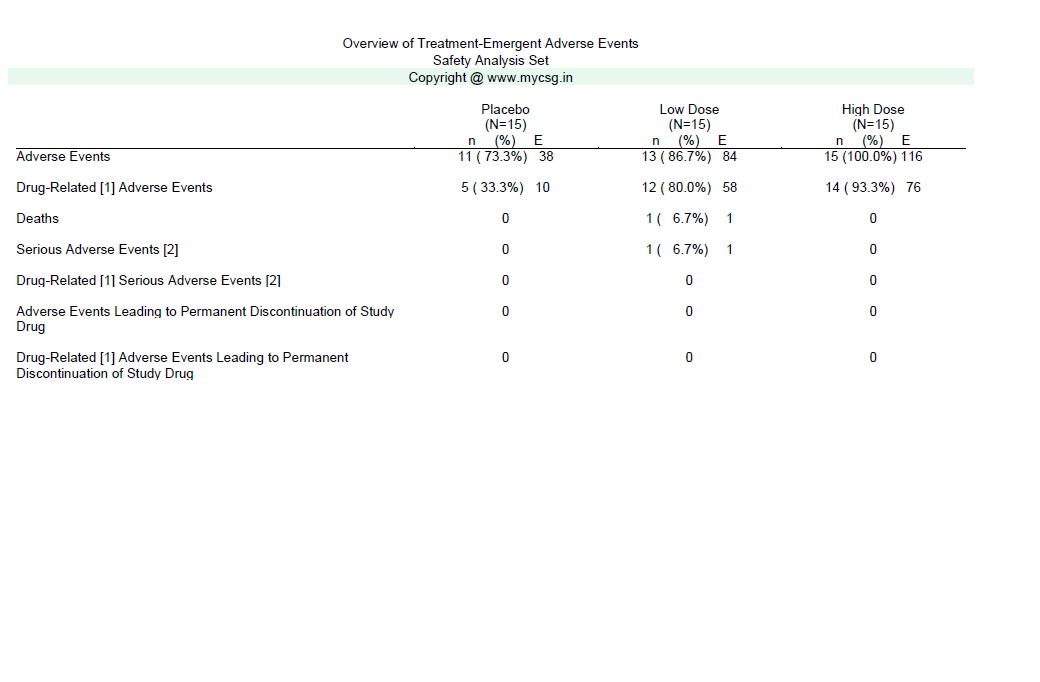
Overview of Treatment-Emergent Adverse Events Safety Analysis Set |
||||
|
Dose level 1 (N=XX) n (%) m |
Dose level 2 (N=XX) n (%) m |
Dose level 3 (N=XX) n (%) m |
Total (N=XX) n (%) m |
|
| Adverse Events | xx (xx.x) xx | xx (xx.x) xx | xx (xx.x) xx | xx (xx.x) xx |
| Drug-Related [1] Adverse Events | xx (xx.x) xx | xx (xx.x) xx | xx (xx.x) xx | xx (xx.x) xx |
| Deaths | xx (xx.x) xx | xx (xx.x) xx | xx (xx.x) xx | xx (xx.x) xx |
| Serious Adverse Events [2] | xx (xx.x) xx | xx (xx.x) xx | xx (xx.x) xx | xx (xx.x) xx |
| Drug-Related [1] Serious Adverse Events [2] | xx (xx.x) xx | xx (xx.x) xx | xx (xx.x) xx | xx (xx.x) xx |
| Adverse Events Leading to Permanent Discontinuation of Study Drug |
xx (xx.x) xx | xx (xx.x) xx | xx (xx.x) xx | xx (xx.x) xx |
| Drug-Related [1] Adverse Events Leading to Permanent Discontinuation of Study Drug |
xx (xx.x) xx | xx (xx.x) xx | xx (xx.x) xx | xx (xx.x) xx |
| Percentages are calculated based on number of subjects in each treatment of the population specified. n = number of subjects with at least one with adverse event. E = number of events [1] Events with relationship recorded on CRF as "POSSIBLE" "PROBABLE" [2] Events with seriousness recorded on CRF as "YES" Programming notes: Display all the rows presented in the shell even when there are no events reported in that category Do not present percentages when subject count is 0 |
Already registered! Login
Not registered, you can signup here! Signup
Dont want to register?
You can directly purchase this lesson (code+input data) here
You can purchase this lesson (code+input data) here
If you are looking to purchase subscription for full access to data and programs for all lessons (TASKS+SDTM+ADaM+TFLs), you can send us a message on +91-7330--77--66--49-- on Whatsapp.
You can contact us on +91-7330--77--66---49 for purchasing subscription to R programs and data
You can contact us on +91-7330--77--66---49 for purchasing subscription to R programs and data