myCSG © |Area: SDTM| Concept: AE : Adverse Events | Lesson: LCSG001 : Adverse Events Programming for study CSG001 |
Background |
|
In clinical trials, when taking a drug or investigational product, the trial participant (subject) may experience some untoward medical occurrences along with the intended effect of the drug. These untoward medical occurrences are called 'Adverse events'. An adverse event (AE) is any untoward medical occurrence in a patient or clinical investigation subject administered a pharmaceutical product and which does not necessarily have a causal relationship with this treatment. An adverse event can therefore be any unfavorable and unintended sign (including an abnormal laboratory finding), symptom, or disease temporally associated with the use of a medicinal (investigational) product, whether related to the medicinal (investigational) product. |
What type of information is typically collected or presented? |
|
In this lesson, we learn the below things:
- How to write a programming specification for this domain
- How to interpret an existing SDTM programming specification
- How to program as per the specification
- How to convert raw dates to SDTM compliant ISO 8601 date values
- How to create study day variables
- How to derive EPOCH variable using subject elements dataset
- How to derive --SEQ variable
- How to create labels for variables using attributes statement
- How to create a supplementary domain
- How to convert a sas dataset into xpt format using proc copy and xport engine of libname statement
| variable_name | variable_label | derivation |
|---|---|---|
| STUDYID | Study Identifier | Equals to the value from raw.adverse.STUDY |
| DOMAIN | Domain Abbreviation | Assign as 'AE' |
| USUBJID | Unique Subject Identifier | Derive by concatenating raw.adverse.STUDY and raw.adverse.PT variable values, separated with a hyphen in between |
| AESEQ | Sequence Number | Sort the records by USUBJID, AEDECOD, AESTDTC and set to 1 on the first record for each subject, and increment by 1 for each subsequent record within the subject. 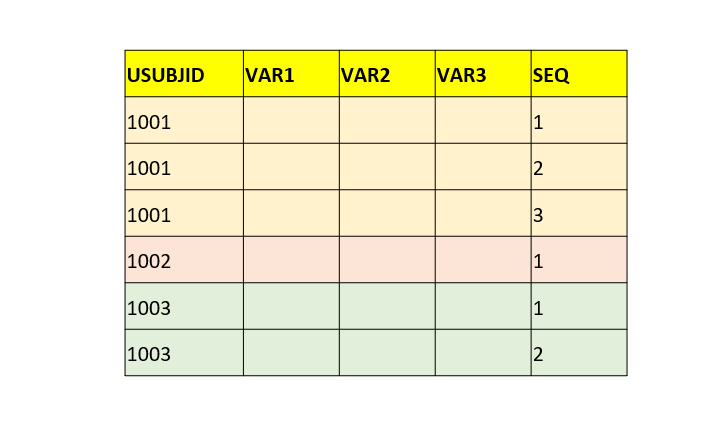 |
| AETERM | Reported Term for the Adverse Event | Equals to the value from raw.adverse.AEVT |
| AELLT | Lowest Level Term | Equals to the value form raw.adverse.AELLT |
| AEDECOD | Dictionary-Derived Term | Equals to the value from raw.adverse.AEDECOD |
| AECAT | Category for Adverse Event | Equals to the value from raw.adverse.AECAT |
| AEBODSYS | Body System or Organ Class | Equals to the value from raw.adverse.AEBODSYS |
| AESEV | Severity/Intensity | Equals to the value from raw.adverse.AESEV, after converting to standard controlled terminology |
| AESER | Serious Event | Equals to the value form raw.adverse.AESER, after converting to standard controlled terminology |
| AEACN | Action Taken with Study Treatment | Equals to the value from raw.adverse.AEACN, after converting to standard controlled terminology |
| AEACNOTH | Other Action Taken | Equals to the value from raw.adverse.AEACNOTH |
| AEREL | Causality | Equals to the value from raw.adverse.AEREL, after converting to standard controlled terminology |
| AEOUT | Outcome of Adverse Event | Equals to the value form raw.adverse.AEOUT, after converting to standard controlled terminology |
| AESCONG | Congenital Anomaly or Birth Defect | Equals to the value from raw..adverse.SCONG, after converting to standard controlled terminology |
| AESDISAB | Persist or Signif Disability/Incapacity | Equals to the value from raw..adverse.SDISAB, after converting to standard controlled terminology |
| AESDTH | Results in Death | Equals to the value from raw..adverse.SDEATH, after converting to standard controlled terminology |
| AESHOSP | Requires or Prolongs Hospitalization | Equals to the value from raw..adverse.SHOSP, after converting to standard controlled terminology |
| AESLIFE | Is Life Threatening | Equals to the value from raw..adverse.SLIFE, after converting to standard controlled terminology |
| AESMIE | Other Medically Important Serious Event | Equals to the value from raw..adverse.SMIE, after converting to standard controlled terminology |
| EPOCH | Epoch | Derive by comparing sdtm.ae.AESTDTC with the sdtm.se.SESTDTC and sdtm.se.SEENDTC of each element of a subject and assign the epoch based on the sdtm.se.EPOCH of the element in which each event start date falls. 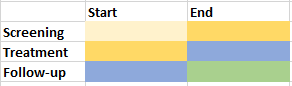 |
| AESTDTC | Start Date/Time of Adverse Event | Equals to the value from raw.adverse.AESTDT_RAW, after converting to ISO 8601 format |
| AEENDTC | End Date/Time of Adverse Event | Equals to the value from raw.adverse.AEENDT_RAW, after converting to ISO 8601 format |
| AESTDY | Study Day of Start of Adverse Event | If the event date is on or after reference start date then sdtm.ae.AESTDTC-sdtm.dm.RFSTDTC +1. Else if date is before reference start date then assign as sdtm.ae.AESTDTC-sdtm.dm.RFSTDTC. 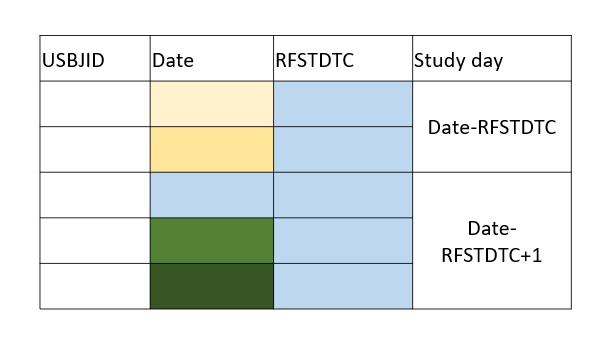 |
| AEENDY | Study Day of End of Adverse Event | If the event date is on or after reference start date then sdtm.ae.AEENDTC - sdtm.dm.RFSTDTC +1. Else if date is before reference start date then assign as sdtm.ae.AEENDTC-sdtm.dm.RFSTDTC. |
| PREFDOSE | Prior to First Dose? | Equals to the value from raw.adverse.PREFDOSE |
| AETRTEM | Treatment Emergent Flag | Derive by using the information present in raw.adverse.PREFDOSE and comparing sdtm.ae.AESTDTC with sdtm.dm.RFSTDTC and sdtm.dm.RFXENDTC. If raw.adverse.PREFDOSE="Y" then set to "N". Else if sdtm.ae.AESTDTC is on or after sdtm.dm.RFSTDTC but before (sdtm.dm.RFXENDTC+15) then set to "Y". Else set to "N". |
Already registered! Login
Not registered, you can signup here! Signup
Dont want to register?
You can directly purchase this lesson (code+input data) here
You can purchase this lesson (code+input data) here
If you are looking to purchase subscription for full access to data and programs for all lessons (TASKS+SDTM+ADaM+TFLs), you can send us a message on +91-7330--77--66--49-- on Whatsapp.
You can contact us on +91-7330--77--66---49 for purchasing subscription to R programs and data
You can contact us on +91-7330--77--66---49 for purchasing subscription to R programs and data