myCSG © |Area: ADaM| Concept: C1001 : Subject Level Analysis Data | Lesson: L101 : Derivation of key date variables which are commonly used on ADSL |
|
|
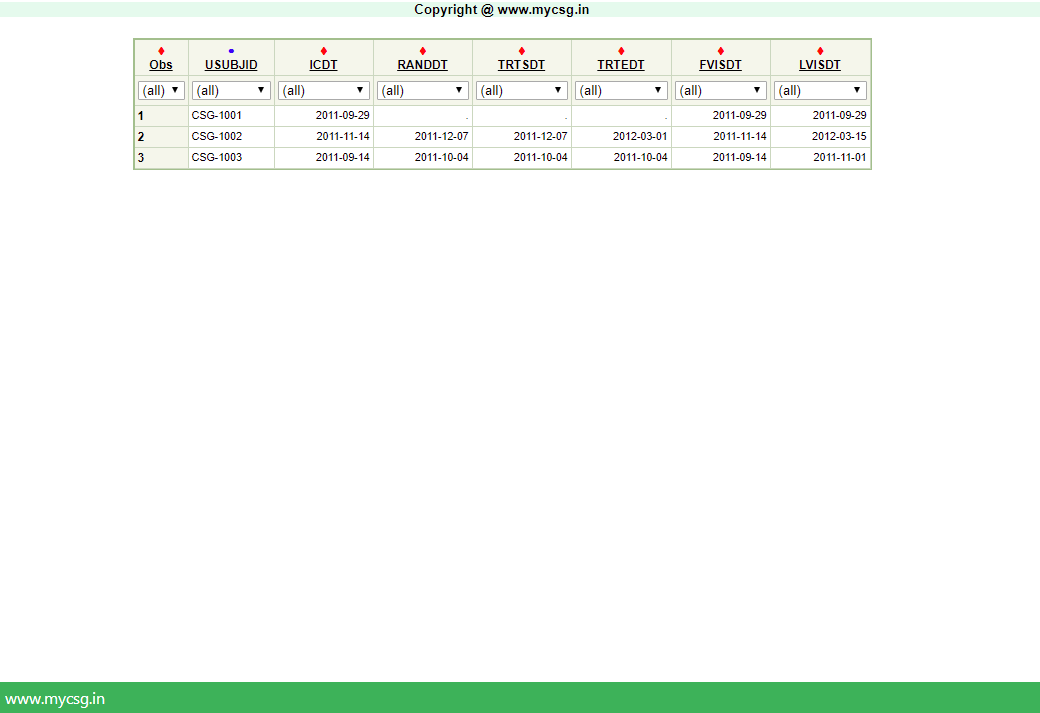
In this lesson we will see how to derive some of the key date variables in ADSL dataset.
- Variables based on disposition data (SDTM.DS)
- Date of informed consent (RFICDT)
- Date of randomization (RANDDT)
- Variables based on exposure data (SDTM.EX)
- Date of first exposure to treatment (TRTSDT)
- Date of last exposure to treatment (TRTEDT)
- Variables based on subject visits data (SDTM.SV)
- Date of first visit
- Date of last visit
SAS programming aspects covered in this lesson are:
- Filtering required records using where statement or if statement
- Selecting earliest or latest records using first. or last. approach
- Extracting a substring from a string
- Converting character date values to numeric date values
- Usage of keep statement to select only required variables from an input dataset
- Sorting observations in ascending or descending order based on required variables
- Merging two or more datasets based on key variables
- Usage of in= dataset option to identify whether a dataset contributed to an observation when merging
| VARIABLE_NAME | VARIABLE_LABEL | DERIVATION |
|---|---|---|
| RFICDT | Date of Informed Consent | Using DS dataset - get RFICDT as the numeric(datepart(DSSTDTC)) on the record where DSCAT="PROTOCOL MILESTONE" and DSSCAT="INFORMED CONSENT OBTAINED" and DSDECOD="SUBJECT INFORMED CONSENT". Note that this date will be missing if the subject has not signed the informed consent (or in case the team fails to capture the data in the DS dataset) |
| RANDDT | Date of Randomization | Using DS dataset - get RANDDT as the numeric(datepart(DSSTDTC)) on the record where DSCAT="PROTOCOL MILESTONE" and DSDECOD="RANDOMIZED". Note that this date will be missing if the subject has not been randomized for any reason (or in case the team fails to capture the data in the DS dataset) |
| TRTSDT | Date of First Exposure to Treatment | Using EX dataset - get TRTSDT as the numeric(datepart(EXSTDTC)) of the earliest record of a subject where EXCAT="TREATMENT PERIOD". Note that this date will be missing the subject has not been exposed to study treatment for any reason (or in case the team fails to capture the data in the EX dataset). Details: Subset the records from EX with the above given condition and sort by USUBJID and EXSTDTC and pick the earliest non-missing date. |
| TRTEDT | Date of Last Exposure to Treatment | Using EX dataset - get TRTEDT as the numeric(datepart(EXENDTC)) of the latest record of a subject where EXCAT="TREATMENT PERIOD". Note that this date will be missing the subject has not been exposed to study treatment for any reason (or in case the team fails to capture the data in the EX dataset). Details: Subset the records from EX with the above given condition and sort by USUBJID and EXENDTC and pick the latest non-missing date. Also note that this is the simplest case of derivation of TRTEDT - there can be multiple conditions to check for depending on how to handle ongoing subjects - which will be protocol specific |
| FVISDT | Date of First Visit | Using SV dataset - get FVISDT as numeric(datepart(SVSTDTC)) of the earliest record of a subject. Details: Sort the SV dataset by USUBJID and SVSTDTC and pick the earliest non-missing date. |
| LVISDT | Date of Last Visit | Using SV dataset - get LVISDT as numeric(datepart(Maximum of SVSTDTC,SVENDTC of a subject)) of the latest record of a subject. Details: If a subject has started a visit, but not ended the visit yet (ongoing visit), picking the last visit date solely by using SVENDTC will not provide accurate information- so a combination of SVSTDTC and SVENDTC has to be used to pick latest availabe date for a subject in SV |
Complete SAS code to generate the output is available for registered users!
Already registered! Login
Not registered, you can signup here! Signup
Dont want to register?
You can directly purchase this lesson (code+input data) here
Already registered! Login
Not registered, you can signup here! Signup
Dont want to register?
You can directly purchase this lesson (code+input data) here
You can purchase this lesson (code+input data) here
If you are looking to purchase subscription for full access to data and programs for all lessons (TASKS+SDTM+ADaM+TFLs), you can send us a message on +91-7330--77--66--49-- on Whatsapp.
R data is available only for R subscribers.
You can contact us on +91-7330--77--66---49 for purchasing subscription to R programs and data
You can contact us on +91-7330--77--66---49 for purchasing subscription to R programs and data
R codes are available only for R subscribers.
You can contact us on +91-7330--77--66---49 for purchasing subscription to R programs and data
You can contact us on +91-7330--77--66---49 for purchasing subscription to R programs and data